
With the end of Maestro, co-badge has established itself as a new operating model in the German debit market. A national card product is being replaced by a debit card that opens up several payment worlds at once: girocard domestically combined with international schemes for e-commerce, wallets, use abroad and additional acceptance scenarios.
New partnerships, such as with Discover, show that the model is evolving. At the same time, banks in the German market are pursuing different strategies regarding debit cards. Whilst large institutions in particular continue to rely on the combination of girocard and Co-Badge (Visa Debit, Mastercard Debit), other banks are moving more strongly towards international debit models. Finanz-Szene recently published an overview of this.
The target architecture has therefore not yet been definitively defined in many places. What initially appears to be a pragmatic product solution, however, turns out to be a profound change for banking IT. This is because co-badging is not a card feature – but an architectural issue.
From card product to orchestration
The classic girocard has long been a stable instrument for national POS and ATM use. With Co-Badge, it becomes a multi-scheme access medium. A single card combines multiple payment logics, which are activated depending on the usage context – in brick-and-mortar retail, at ATMs, in e-commerce or in a digital wallet.
This shifts the focus from the card itself to the bank’s ability to recognise these contexts and manage them technically. Co-Badge thus becomes an orchestration task.
Co-Badge routing as a central control mechanism
At the heart of this orchestration lies Co-Badge routing. Banks must define which badge is used in which context – including routing rules, scheme priorities, fallbacks and override options. These decisions are not purely technical. Scheme selection influences costs, revenues, acceptance reach and the volume of complaints. At the same time, merchants, acquirers and regulatory requirements influence routing. For instance, retailers often prefer the more cost-effective method.
Routing thus becomes a strategic lever – and requires an architecture that brings together technical logic and economic objectives.
An example illustrates the complexity: the customer uses the same co-badged card at the supermarket via girocard, in an online shop via an international scheme, tokenised in a wallet, and at an ATM abroad in yet another usage context. For the customer, it remains ‘one card’ – but for the bank, this gives rise to different decision-making and processing models.
Authorisation and risk management are converging
With multi-scheme usage, the demands on authorisation and fraud detection are increasing. A PIN-based POS or GAA transaction differs fundamentally from a card-not-present scenario in e-commerce. Authorisation and fraud detection must therefore be integrated in real time. Modern systems make risk decisions directly within the transaction flow – increasingly supported by AI.
Multi-scheme processing as the new normal
With co-badging, the parallel operation of multiple schemes becomes the norm. This affects clearing, settlement, reconciliation, as well as complaints and chargeback processes. As each scheme brings its own formats and workflows, complexity does not increase linearly, but disproportionately. Without a consolidating platform architecture, ad-hoc solutions and manual dependencies quickly arise.
Increasing complexity in testing and operations
This multi-layered structure has a direct impact on testing and operations. Changes must be validated across multiple schemes, channels and end devices – both in depth and breadth. At the same time, existing girocard POS and GAA channels must be operated reliably. Banks are thus faced with the challenge of ensuring innovation and stability in parallel.
Legacy systems as a structural bottleneck
Many existing systems are not designed to meet these requirements. They are often batch-oriented, monolithic and tailored to individual schemes. Co-Badge can, however, be deployed on top of existing landscapes. However, this model will only be sustainable in the long term if a central orchestration architecture is established. This must recognise usage contexts, make routing decisions, integrate authorisation and risk management, and encapsulate scheme-specific processing.
This is precisely where current transformation approaches come into play: by decoupling legacy systems via API and orchestration layers, defining clear routing and decision-making logic, and standardising operational processes and interfaces.
The aim is to provide payment transaction functions in a modular manner – as reusable building blocks with defined features, parameters and SLAs.
Outlook: from co-badge to multi-badge
The development does not end with the co-badge. Looking ahead, multi-badge models will emerge in which further payment channels are integrated. This also brings the issue of sovereignty more sharply into focus. Co-badge ensures reach, but at the same time increases dependence on global providers. Banks must therefore design their architecture in such a way that new processes can be integrated flexibly.
Co-badge is not a transitional phenomenon, but the start of a new phase in payment transactions. The actual transformation is taking place in banking IT: towards orchestrated, modular systems that integrate routing, authorisation, fraud management and multi-scheme processing. Banks that treat co-badge merely as a product are underestimating this shift. The ability to manage payment processes flexibly, cost-effectively and resiliently will be crucial.
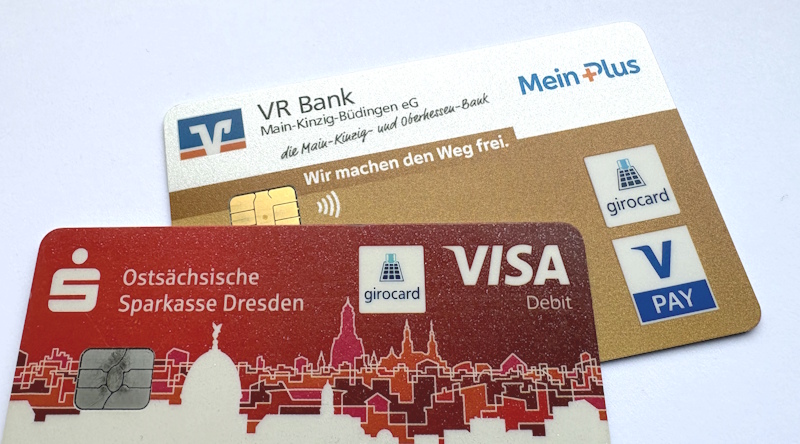
Co-Badge Girocards from Ostsächsische Sparkasse Dresden and VR Bank Main-Kinzig-Büdingen