

Why the integration of digital identities into banking and self-service infrastructures is becoming a key priority – and what role EUDI Payments play in this.
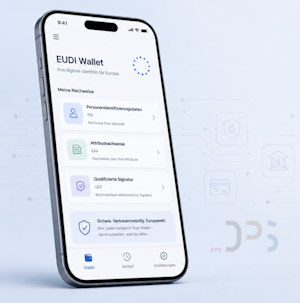 With the revised eIDAS Regulation, a European infrastructure for digital identities is currently taking shape: the EUDI Wallet. In future, citizens will be able to use it to verify their identity and present digital credentials across Europe. This article focuses on the EUDI Wallet for natural persons. Concepts for digital identities of legal entities – such as in the context of a European Business Wallet – are not explored in depth here.
In practice, this presents a twofold challenge for financial institutions: firstly, to what extent they will need to accept and regulate wallet-based identities in future.
Secondly, what additional benefits can be derived from integrating this identity data into existing banking and payment systems. Processes such as digital identification, authentication or contract conclusion are closely linked to existing IT architectures in banks – from core banking systems and compliance applications to self-service infrastructures.
The introduction of the EUDI Wallet therefore directly affects the institutions’ existing system landscape.
New role for banks in the identity ecosystem
In the EUDI Wallet’s architectural model, organisations typically act as so-called relying parties – that is, as organisations that request identity data or attribute claims from a wallet and use them in their processes.
The wallet provides several building blocks for this purpose, which are also relevant to banking processes:
- Personal Identification Data (PID): A standardised data set containing basic identity information such as name, date of birth or nationality.
- Electronic Attestations of Attributes (EAA): Digital proofs of individual attributes, such as age, address or professional qualifications.
- Qualified Electronic Signatures (QES): Legally compliant digital signatures, for example for concluding contracts or powers of attorney.
For banks, this opens up specific areas of application – for example in KYC and onboarding processes, in authentication procedures and payment authorisations in online or corporate banking, as well as in digital contract conclusion.
The EUDI wallet therefore affects not only customer identification, but potentially many interactions between banks and their customers.
Integration into existing banking infrastructures
The real challenge lies not in the wallet itself, but in its integration into existing systems and processes. For banks, the first question is which identity and attribute data from the wallet are required in the respective business processes.
In addition to basic personal identification data (PID), digital attribute credentials can also be used – for example, in the context of KYC checks, authentication procedures or contract processes. This information must be integrated into existing customer and process data and further processed within the bank’s architecture.
Added to this is the assessment of the trust level of the identity data provided. Depending on the use case, it may be necessary to process qualified proofs or particularly high trust levels – for example, in the case of regulatory processes.
Technically, the connection is established via standardised interfaces to the wallet ecosystem, through which applications can request and process identity data and verifiable proof from the wallet (e.g. via OpenID-based procedures such as OpenID4VP or OpenID4VCI). These interfaces must be integrated into existing banking architectures – such as core banking systems, payment back-ends or compliance applications.
AML & EUDI Wallet: Key Dates & Facts
From 10 July 2027, EU Regulation 2024/1624 (AMLR) will take direct effect and establish the EUDI Wallet as a tool for KYC processes. From December 2027, in accordance with eIDAS 2.0 (Regulation 2024/1183), there will be a legal obligation for banks, as well as for the real estate and crypto sectors, to accept the EUDI Wallet. Remote identification with a high level of assurance will become the prevailing standard and may replace existing procedures such as video identification. Technically, KYC is carried out via digital attribute verification and qualified electronic signatures, enabling seamless contract processes.
EUDI Payments
Against this backdrop, the term ‘EUDI Payments’ is also increasingly being used in technical discussions. This refers to the closer integration of digital identity, attribute verification and payment processes within a shared transactional context.
In such scenarios, identification, authentication and payment are no longer considered separately, but are combined into an integrated process – for example, in age verification at the point of sale or in e-commerce transactions. Technically, this is also based on the interfaces described between applications, browsers and wallets.
The introduction of the EUDI wallet is therefore not merely an identity or compliance issue for banks, but an integration project with a direct link to the existing payment infrastructure.
Practical tests in the EUDI sandbox
To clarify such integration issues at an early stage, the German government launched a sandbox for the EUDI wallet at the end of January 2026. In this test environment, companies and public authorities are developing specific application scenarios and testing technical integrations.
DPS is also participating in this initiative.
Our research focuses on the question of how wallet-based identities can be integrated into existing service and infrastructure environments – for example, in self-service scenarios at terminals through which citizens or customers can use services independently.
Conclusion
The EUDI wallet will become an integral part of the European identity infrastructure in the coming years. For banks, this raises one practical question above all: how can the new identity mechanisms be meaningfully integrated into existing systems and processes?
It is precisely at this point that the added value the wallet can actually deliver in day-to-day banking operations will be determined. Those who address the technical and organisational integration issues at an early stage will lay the foundations for integrating digital identity stably and efficiently into existing banking and service infrastructures in the future.