

By Bernhard Uitz and Lukas Romeiser
“Start testing now.” The message of the recently published European Testing Plan for the T+1 roll-out could hardly have been clearer.
Whilst the official market tests will not take place until 2027, banks, securities firms and market infrastructures are expected to begin their preparations today. The reason is obvious: with the settlement cycle being shortened to one business day, it is no longer sufficient to simply test individual systems successfully. The interaction of entire process chains across institutional and market boundaries will be crucial.
This is precisely why test management is becoming one of the key success factors in the European T+1 transition.
T+1 affects the entire transaction chain – from trading venues and clearing houses, through depositories and custodians, to banks, brokers and institutional investors. Accordingly, quality assurance must also extend beyond individual applications and system boundaries.
T+1 testing does not begin in 2027
Many market participants associate T+1 testing primarily with the Europe-wide test windows planned for 2027. These will undoubtedly play an important role. However, anyone who only begins preparations then will lose valuable time.
Even now, numerous institutions are analysing their existing process chains, identifying time-critical processing steps and examining where organisational or technical dependencies could lead to delays. The aim is to create the conditions necessary for transactions to be processed within the significantly shorter timeframes in future.
The focus here is on questions such as:
- Where do business or technical process bottlenecks occur today?
- Which processing steps cause delays?
- Which workflows are not yet sufficiently automated?
- How quickly can errors be detected and rectified?
- What dependencies exist with internal and external partners?
These questions already demonstrate that T+1 test management goes far beyond the traditional execution of test cases. Before end-to-end tests can be carried out effectively with market partners, a firm’s own processes must be sufficiently transparent and robust.
No Europe-wide test case catalogue
It is noteworthy that the European T+1 testing strategy deliberately avoids a mandatory test case catalogue. Unlike many regulatory initiatives, there is no central list of mandatory test scenarios that all market participants must carry out in exactly the same way.
Instead, the European T+1 initiative adopts a risk-based approach. Each institution is required to analyse its own individual process chains, products, markets and dependencies, and to derive its own test strategy from this analysis.
The focus is less on individual test cases and more on key questions regarding operational performance:
- How quickly are settlement instructions created and sent?
- What are the matching rates?
- How efficiently can exceptions and errors be handled?
- Which manual interventions currently interrupt the STP process?
- What dependencies exist with regard to counterparties, custodians or market infrastructures?
The European bodies specifically highlight four key performance indicators that institutions should monitor: the speed of allocation and confirmation, the timing of instruction generation, matching rates and settlement efficiency. This makes test management a management task. It requires not only testers and specialist departments, but also programme managers, operations units and process owners.
From process analysis to end-to-end testing
In many organisations, current activities initially focus on optimising individual process steps. This is sensible and necessary. After all, only processes that are already largely automated and running stably today can function successfully in a T+1 environment.
In our view, the T+1 testing strategy can be divided into three stages.
Internal tests and process analyses form the basis. The aim here is to measure turnaround times, identify manual process steps, eliminate STP breaks and speed up existing workflows.
Building on this, bilateral testing is becoming increasingly important. Banks, brokers, custodians and other market participants can already run through scenarios together, exchange messages and verify how their processes interact. Such tests often yield valuable insights that cannot be gained in purely internal test environments.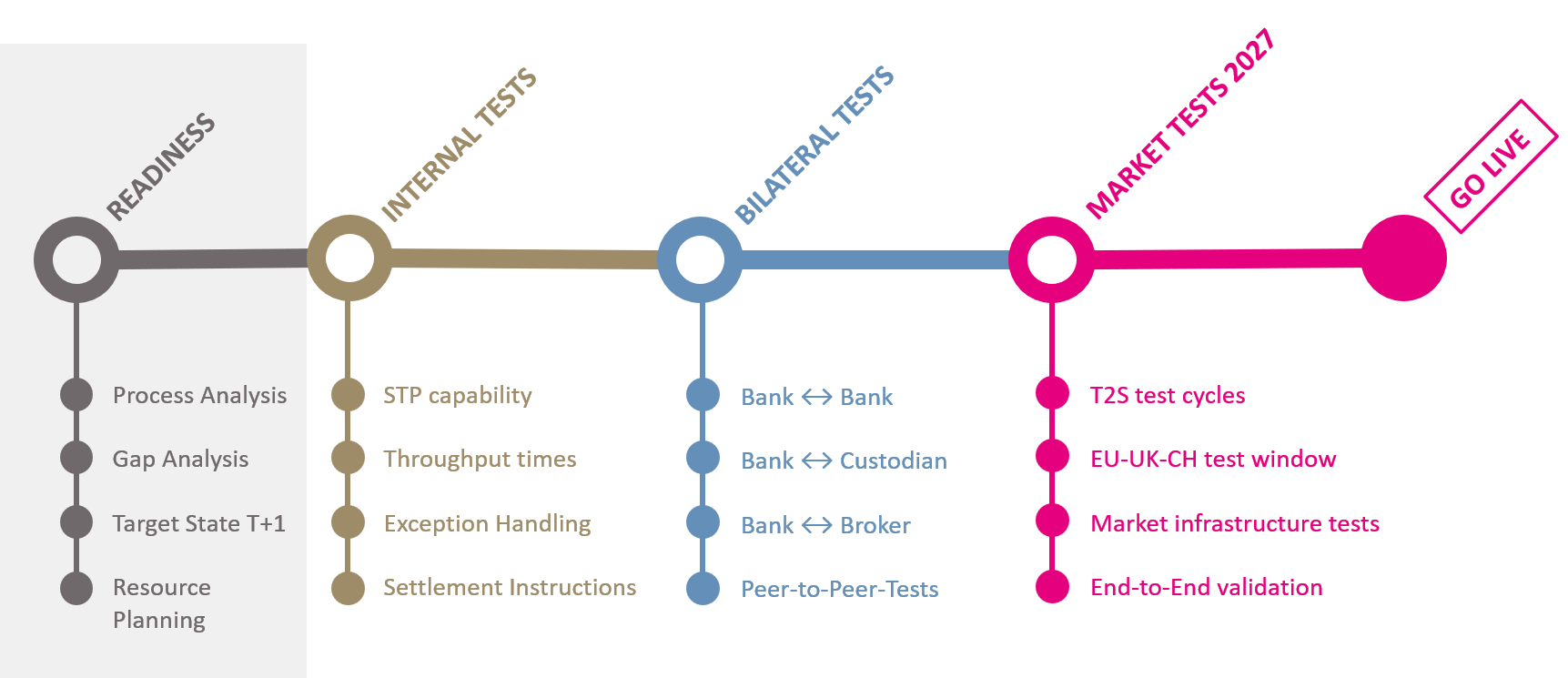
It is only at the third stage that large-scale, market-wide tests take place, in which numerous market participants jointly verify their T+1 capability. The European Testing Plan provides for five coordinated test windows in 2027: early February, late April, late May, late June to early July, and late August to early September.
Whilst these tests in the UK and Switzerland primarily address cross-market interaction, an additional aspect comes into play in the EU: preparation for the new T2S Operational Day, including the Settlement Optimisation Gating Event. The relevant changes will come into effect as early as 14 June 2027 and can be thoroughly tested during an additional test period between April and October 2027.
This sequence is important. Market-wide tests can only be successful if the participating institutions have already completed their internal preparations.
Bilateral tests are gaining in importance
We currently see considerable potential in this area in particular.
Understandably, many institutions initially focus on their own systems and processes. At the same time, however, there is a risk that critical dependencies on counterparties, custodians or other service providers will only become apparent at a very late stage.
The European Testing Plan therefore expressly recommends so-called peer-to-peer tests with selected counterparties. Institutions should test together at an early stage, exchange messages and run through process chains under realistic conditions.
Bilateral tests already offer the opportunity to simulate real-world process chains under T+1 conditions. For example, institutions can exchange settlement instructions, review matching processes or jointly analyse typical exception cases.
The advantage is clear: problems become apparent sooner. At the same time, joint solutions can be developed before the time pressure of the actual transition intensifies.
In our view, banks and securities firms should make targeted use of the time leading up to the official market tests to establish such collaborations. Those who wait until the major test windows open are missing out on valuable insights.
T+1 and Fontus: Test management becomes a coordination task
In the T+1 environment, test management is not limited to the planning and execution of tests. Equally important is the coordination of resources, specialist departments and testing capacities across several parallel transformation projects.
The Fontus project by WM Datenservice plays a particularly important role for German banks and securities firms. As DPS has highlighted in several articles on the project’s development, the upcoming tests in the Fontus environment are also expected to tie up considerable resources within the institutions. Although the detailed timetable is still subject to ongoing consultation, it is already becoming apparent that the preparation and testing phases for T+1 and Fontus will run, at least in part, in parallel. DPS will publish a recent update on the further Fontus planning shortly. For the market participants concerned, this significantly increases the demands on planning, prioritisation and resource management.
This makes it clear that those responsible within the institutions must not only keep an eye on the actual T+1 transformation. At the same time, it is already necessary to consider how test resources, subject matter experts and environments can be allocated for further market-wide projects. In particular, the tranche tests within the Fontus environment are also expected to tie up considerable capacity.
Test automation as a strategic opportunity
However, this very situation also presents an opportunity. When the testing periods and resource requirements of several large-scale projects coincide, the automation of testing processes becomes even more important. Institutions can use the upcoming projects to standardise end-to-end testing more effectively from the outset and carry it out automatically. The main challenge here lies in integrating external market participants, service providers and data suppliers. At the same time, it is precisely this area that offers considerable potential for using scarce testing resources more efficiently and sustainably improving the quality of test execution.
Successful test management therefore also means identifying dependencies between different programmes at an early stage and drawing up realistic plans for staffing, test environments and technical support.
Our conclusion
The European T+1 testing strategy makes it clear that readiness does not begin only with the official market tests. Institutions should already be analysing their process chains, identifying critical dependencies and conducting initial tests in collaboration with market partners.
Anyone who views T+1 solely as an infrastructure project is missing the point. The success of the transition will be determined above all where processes, people and systems interact for the first time under realistic conditions.
This article concludes our T+1 series. Together with our experts, we have examined various perspectives on the European T+1 transition – from scoping and dependencies through to implementation and the challenges posed by legacy architectures.