
With DAC8, new tax reporting obligations for crypto-asset service providers have been in force since the start of 2026. In Germany, the first reports for the calendar year 2026 must be received by the Federal Central Tax Office (BZSt) by 31 July 2027. Alongside the substantive implementation of the Crypto-Asset Reporting Framework (CARF), the focus is now also shifting to the technical transmission of data. The DIP interface is available for automated reporting. The challenges that may arise in this context are illustrated by DPS’s experience with CESOP reporting.
CARF defines the substantive requirements
The basis for DAC8 is the Crypto-Asset Reporting Framework (CARF) developed by the OECD. It specifies which information regarding crypto-asset users and their transactions must be collected and reported for tax purposes. This includes, in particular, tax residency, tax identification numbers (TINs) and aggregated data on purchases, sales and transfers of crypto-assets.
Many Crypto Asset Service Providers (CASPs) already hold relevant customer and transaction data through MiCAR, KYC/AML processes and the Travel Rule. However, this data may need to be supplemented, consolidated and prepared in accordance with the specific reporting requirements for CARF.
Germany: CARF reports via the DIP interface
With the Crypto Asset Tax Transparency Act (KStTG), Germany has transposed DAC8 into national law. On 14 January 2026, the Federal Ministry of Finance published the technical specifications for data transmission to the BZSt.
The DIP interface (Digital Inbox) is intended for the automated transmission of bulk data. In this process, the technical reporting data in CARF XML format is embedded within a higher-level DIP message structure. Alternatively, a manual XML upload via the BZSt online.portal is possible.
The technical implementation therefore encompasses not only the creation and validation of the CARF data, but also its integration into the national reporting infrastructure. This is complemented by the processing of feedback, error analysis and the organisation of correction and follow-up reports.
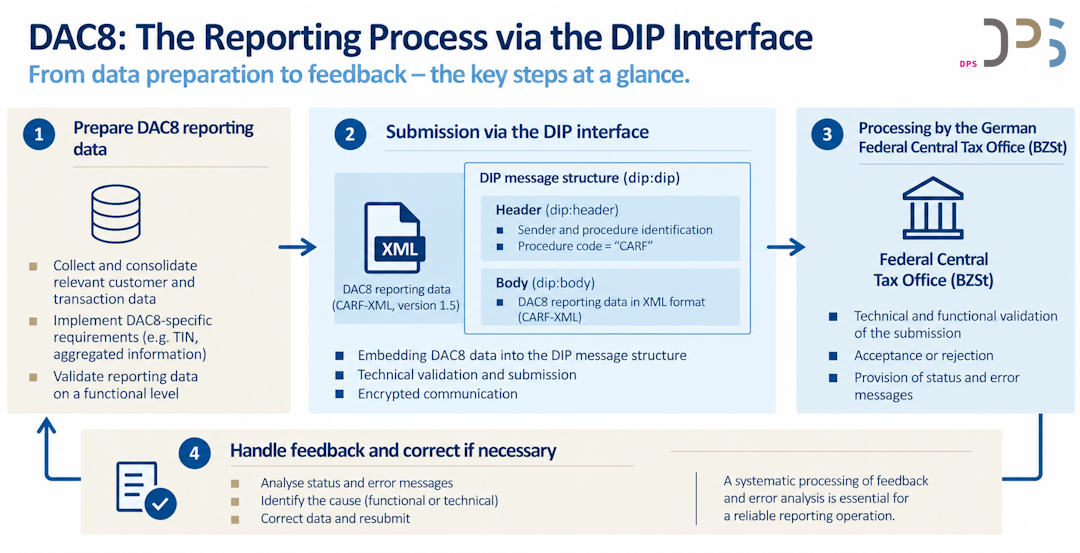 Illustration of the DAC8/CARF reporting process via the DIP interface. Proprietary, AI-generated graphic based on the technical specifications issued by the Federal Ministry of Finance (BMF) on 14 January 2026.
Lessons learnt from CESOP: When reports are rejected
DPS’s experience with CESOP reporting demonstrates that the technical transmission of regulatory reports during live operations can be challenging. As part of our CESOP Compliance Service, we have repeatedly encountered changes to technical specifications, discrepancies between test and production environments, and error messages that are difficult to interpret.
For example, a change in the processing of XML namespaces led to reports that had previously been accepted suddenly being rejected with a non-specific error code. For the submitter, the cause of such rejections is not always immediately apparent: it may lie in either the substantive reporting data or the technical communication.
These practical experiences from CESOP reporting are also relevant to DAC8. They highlight the importance of systematic error analysis, monitoring technical changes and adaptable operational processes. It remains to be seen whether, and to what extent, comparable problems will arise in the CARF reporting process.
DAC8 reporting: Plan for operations at an early stage
For crypto-asset service providers subject to reporting requirements, implementation does not end with the provision of a CARF-compliant data set. Equally important is a robust technical reporting architecture that takes into account validation, transmission, feedback processing and corrections.
DPS supports banks, financial service providers and crypto-asset service providers in implementing regulatory reporting requirements. Through our CESOP Compliance Service, we have practical experience in connecting to the BZSt and in operating DIP communication.
We also apply this expertise to the assessment and design of DAC8/CARF reporting processes – from the analysis of existing data and systems through to technical integration and the design of reliable operational processes.
Are you working on the technical implementation of your DAC8 reporting obligations? Talk to us about your requirements and possible solutions.